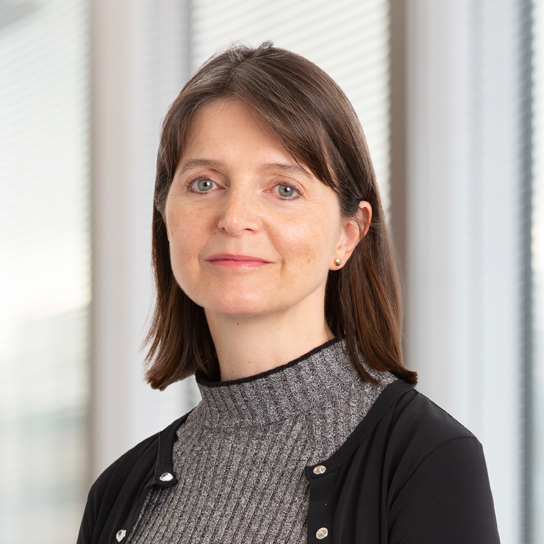
Meet the innovators Dr Marion Palmer on advancing sustainability with science policy and vision
Banner Image

Meet the innovators: Dr. Marion Palmer on advancing sustainability with science, policy, and vision

2 September 2025

A leadership mindset looks at the future, determines where you want to go, and embraces innovation to get there. As we continue our special Q&A series, you’ll get to know some of our movers and shakers who tap into opportunities to drive progress.

In the conversation below, Dr. Marion Palmer, Global Head of Sustainability, Policy and Strategy and 2024 Financial Times Innovative Lawyers Europe honoree, shares what inspires visionary thinking and a future-ready legal approach for herself, her team, and our clients.

How do you encourage visionary thinking in your team?

Everybody’s an authority in what they do, and everybody has great ideas. A lot of times it’s about providing people with the safe space to express those ideas – and the confidence that they will be recognized and appreciated.

Innovation does not occur in isolation. Someone has an idea; somebody else has the experience to know how that idea works out; and somebody else has the practical lens of how much it’s going to cost and how long it will take to execute. In short, innovation is a team effort – encouraged by creating open dialogue where people feel able to express their thoughts.

What inspires you to develop novel solutions for clients and the firm?

All innovation is problem-driven – seeing a problem without a solution and then focusing on the need.

In my work leading global sustainability, one present example is an exercise we’re doing called a “climate scenario analysis,” which examines ways we can be a successful business under possible climate futures – depending on how well we mitigate global warming.


When you consider our global needs – operating in 18+ countries – in balance with more local regulations, like those in the UK, we need to be more creative about how we go about this in order to make sure that we do it in a way that works for all of our people across the firm.


In these kinds of complex discussions, you have to be brave and say, “I think for us it would be better to stand back and think about it in a different way”.

How has technical innovation influenced your approach to scientific analysis in life sciences litigation cases?

The way that we identify and assess scientific data has changed with technological shifts. What stands out most as a highlight to me is the consistent reliability of subject matter experts who we consult.

When I first joined the firm, it took about four weeks to get your hands on scientific journals in order to review evidence to support your cases. You literally had to fill out a carbon copy and send it by post to the British Library, where they’d photocopy the pages you needed and mail it back to you. Now, you can instantly get anything that you need off the internet, and you can go and ask an AI tool for an analysis.


Over the years, one thing that’s remained consistent is the need to assess the validity of the published science. With the wonderful evolution of data availability, that’s probably gotten more difficult because of the sheer volume of data.


But one of the huge privileges of working in science is being able to identify someone with 20+ years of field experience, who understands the literature and how it works out in practice and can give you an objective, unbiased, informed view. Their voice is one we can rely on, and we need that immensely valuable human element – not just our wonderfully supportive technology.


Innovation never stands still. What do you see as the next frontier in sustainability?

There will be – and already is in certain jurisdictions – sustainability and greenhouse gas emissions related litigation. That is going to significantly take off.

We need to think about how the world governs itself over the next few years, particularly in relation to adapting to unavoidable climate change because there’s a certain amount that we already can’t change, and we will see significant impacts by 2030. Planning how we can act in the interim means that we could make a huge difference for people, ten, fifteen years after that.


There will be damage and natural disasters associated with the changing climate, and all of these things ultimately need to be paid for, one way or another. People need to be looked after, and rebuilding projects and adaptation needs to be done.


Now, you can either do that by regulation – having a consistent approach around the globe to generate revenue in some way. Or, if that’s not there, you will end up going down the litigation route, and you will have innumerable, very large-scale litigation cases.


There have been several recent judgements which support the principle of being able to hold organizations accountable for their historic emissions, and I think that is going to launch a huge amount of relevant litigation. That’s one of the things we’re advising clients on – understanding their historic emissions so they can try to start mitigating the impacts of their previous actions, today.


How do you nurture your creativity outside of work?

I have two hobbies: sculpting and gardening. As time allows, I quite enjoy sculpting. It’s very soothing. And I’m very fortunate to have a reasonably sized garden. When we bought our house, it had a sort of derelict swimming pool in it, so I converted that into a pond, and I spend quite a lot of time pottering around, planting trees and watching dragonflies.

What qualities make our clients uniquely positioned to lead change?

Each of our clients are unique and possess so many different qualities. I think fundamentally, with pretty much all the clients I’ve worked with, the key thing is that they really care.

They really care about what they do and their organization and their role in their organization. If you’ve got that mindset of wanting to make sure your organization succeeds, then it enables you to stand back and more objectively look at the world to consider what are the drivers for success.


The quality of the workplace – the colleagues and how happy are you at work – makes a difference. Having a successful organization depends on having the right balance of voices in the room, including those that you might not necessarily agree with at first, because it’s important to listen to them and plan your strategy in a way that will work for them as well as for yourself.


So, I think fundamentally it is that our clients care about the success of their organization and, it goes without saying, have the talent to lead change.

Learn more about Marion and her innovative work at Hogan Lovells.

Discover more of our stories.