
Powering the Future: Energy x Manufacturing

 Search


 Search


With only two months to go until the first set of obligations under the EU Packaging and Packaging Waste Regulation (EU) 2025/40 (PPWR) starts to apply on 12 August 2026, several aspects of practical implementation still remain to be clarified. With its recent Guidance Document on the PPWR and Frequently Asked Questions document (FAQ), the European Commission has now provided some long-awaited clarification on a number of questions. Overall, it should be noted that the Guidance and FAQ are explicitly described as “interpretive” documents and expressly state that they do not replace, add to, or amend the PPWR. In practice, however, they may provide details for a compliance roadmap and will likely influence how national authorities, courts, and supply chain actors interpret and operationalize PPWR obligations. This update provides an overview of key aspects in the Guidance document and the FAQ regarding key definitions, material design requirements, labelling requirements, conformity assessment procedures and extended producer responsibility obligations.
The PPWR entered into force on 11 February 2025, and the first key obligations will start to apply from 12 August 2026, with a number of substantive obligations subject to later application dates and/or future delegated and implementing measures that shall specify individual obligations in more detail. The Commission’s Guidance and the accompanying FAQ seek to support uniform application across Member States by clarifying definitions, timing, and the Commission’s interpretation of selected provisions, while noting that binding interpretation remains with the Court of Justice of the European Union.
The Guidance explains key concepts of the PPWR in more detail, starting with the packaging definition, followed by explanations on the manufacturer and producer definitions.
Definition of packaging
In its explanations on what items constitute packaging within the meaning of the PPWR, the Commission emphasizes the general definition of packaging according to which the intended function of packaging items is to contain, protect, handle, deliver, or present a product without being an integral part of that product. The Guidance adds illustrative examples of different grey area items, ranging from beverage cups to dust bags for shoes and garments to intravenous bags and syringes. As regards beverage cups and dust bags, the Commission differentiates whether the relevant items are sold separately to consumers (no packaging) or with products (in which case these items shall usually qualify as packaging.) With regard to intravenous bags and syringes, the Commission argues that such items – when supplied prefilled – usually form an integral part of the medicinal or medical product itself so that they do not qualify as packaging. Overall, it remains subject to a case-by-case assessment whether a certain item qualifies as packaging subject to the rules of the PPWR or not. Whilst this often may appear rather obvious, the devil is in the detail, and ultimately all items that could potentially be used to contain other products should be carefully assessed.
Manufacturer and producer of packaging
The Guidance provides detailed explanations on the manufacturer and the producer definitions and some important practical guidance. With respect to both definitions, the Commission emphasizes that the definitions were intended to ensure that there can only be one manufacturer in a supply chain and only one producer per packaging in a specific EU Member State. To put it simply, the Commission apparently applies the general rule of thumb that if a person’s name or trademark is on packaging, that person usually qualifies as the packaging’s manufacturer. While this may help with the manufacturer qualification, the rather complex explanations regarding the producer definition show that in practice determining whether a certain actor in the supply chain qualifies as a producer of a certain packaging will require a robust understanding of relevant supply chains. In principle, this must be assessed for all 27 EU Member States if packaged products are distributed across the whole EU. The distinction between sales and transport packaging in the explanations further demonstrates that the producer qualification may lead to different results for the separate layers of packaged products, requiring a granular assessment (e.g., a manufacturer selling a packaged product to a wholesaler in the same country where it is established usually qualifies as the sales packaging’s producer but may not be the producer of the transport packaging where the pre-assembled and unbranded transport packaging has been procured from a supplier established in that same country). In addition, it is important to note that with the harmonized producer definition, existing producer qualifications may change, so that companies should carefully review whether they may qualify as a producer under the new producer definition.
While these explanations provide valuable guidance on the interpretation of key definitions under the PPWR, the fact that a fifth of the Guidance document is dedicated to the explanation of key concepts (with additional explanations, e.g., on “composite packaging” and the assessment of the producer role in the case of distant sales in the FAQ) illustrates how complex it can be in practice to identify relevant obligations when preparing for compliance with the PPWR.
Regarding those specific obligations that packaging will have to meet in terms of its material design, the Guidance provides guidance on certain specific issues; however, significantly more substantial details on practical implementation can be found in the FAQ.
Testing for PFAS limit
Concerning the newly introduced limit for per- and polyfluoroalkyl substances (PFAS) in food-contact packaging, significant uncertainties remain, particularly because there are still no harmonized testing protocols for PFAS in food-contact packaging. The Commission notes that they are working on this in collaboration with involved stakeholders. In the meantime, the Commission suggests applying a staggered approach starting with total fluorine quantification. In addition, the Commission clarified that while relevant PFAS limits apply both with respect to intentionally added and non-intentionally present PFAS, they are usually only exceeded if PFAS were added intentionally. In practice, this may help identify when to scrutinize PFAS presence more closely.
Recyclability of packaging
With respect to the obligation that packaging must be recyclable, the related deadlines in the PPWR caused some confusion given that specific requirements regarding recyclability are envisaged to be published and enter into force only at a later stage. In its Guidance, the Commission clarifies that for the time being the recyclability requirement under the Packaging and Packaging Waste Directive – the predecessor of the PPWR – including the related harmonized standard EN 13430:2004 continues to apply until the more specific design-for-recycling requirements under the PPWR start to apply. Until the relevant delegated act specifying the design-for-recyclability requirement enters into force, recyclability, therefore, would not need to be part of the conformity assessment according to the Commission. Thus, it appears that the general requirement that packaging must be recyclable remains a rather planning-focused obligation with arguably limited immediate practical impact until outstanding delegated acts with substantial specifications enter into force.
Recycled content in plastic packaging
With respect to the obligation that plastic parts of packaging must contain a certain percentage of recycled content, the Commission confirmed that components representing less than 5% of the entire packaging unit’s total weight are exempted from this obligation, as well as, for example, immediate and contact-sensitive packaging. For all those plastic packaging parts that will be subject to the minimum recycled content requirement, the FAQ gives a taste of the documentation efforts that will be required from operators to demonstrate compliance in related technical documentation: according to the FAQ, packaging manufacturing plants will have to provide documentation that demonstrates that the average supply per year to a specific manufacturer meets the recycled content requirement for each packaging type and format.
Packaging minimization
With respect to the upcoming packaging minimization requirement, the Commission confirmed that the existing standard EN 13428:2004 is envisaged to be updated and that industry shall be given the opportunity to contribute to the development of new standards. Irrespective of the details of the relevant update, the FAQ signals that the packaging minimization assessment will not be possible on an abstract level only without considering the relevant characteristics of the packaged product.
The guidance also clarifies the labelling particulars that will be introduced by the PPWR, particularly regarding material composition. This should facilitate consumer-level sorting, as well as be important for reusable packaging and the ability to provide information on the recycled and bio-based content in packaging. In its Guidance, the Commission emphasizes that these newly introduced labelling elements should increase harmonization of packaging labelling. In practice, this means that national packaging labelling requirements informing consumers, for example, about material composition and sorting of the packaging will have to come to an end as soon as the relevant PPWR requirements become applicable. Member States would no longer be allowed to retain national labels in combination with EU harmonized labels. This is expected to strengthen the EU internal market by facilitating the offering of packaging in multiple EU countries without the need for substantial amendments to packaging design.
An initial idea of what harmonized labels for material composition might look like in practice can be drawn from the technical proposal for EU harmonized waste-sorting labels under the PPWR. This proposal was prepared by the Joint Research Centre for the European Commission’s Directorate-General for Environment. While the report is not legally binding, it will inform the drafting of implementing acts establishing harmonized labels to be adopted by the Commission. The implementing act is expected to be adopted by 12 August 2026.
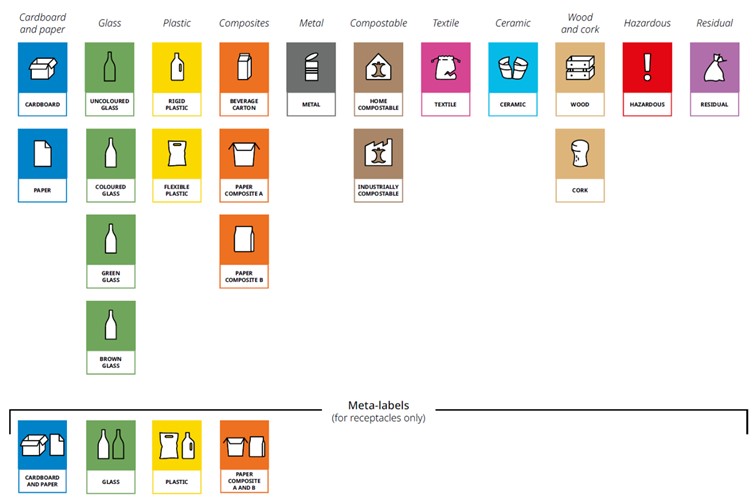
However, neither the Guidance nor the FAQ provides practical guidance on the manufacturer and importer information and the identification element. While these labelling elements, in principle, may already be familiar from other EU product harmonization legislation (e.g., from the EU General Product Safety Regulation), uncertainties regarding their implementation in practice still remain. For example, guidance is missing with regard to the question whether existing identification elements required under other EU legislation for the packaged product may also serve as an identification element under the PPWR, and how to handle packaged products that come with multiple packaging layers (e.g., sweets packaged in small plastic bags that are themselves packaged in a large grouped packaging plastic bag). At the same time, this leaves some leeway for responsible economic operators to find the most practical solutions possible in individual cases.
Under the PPWR, manufacturers will be required to conduct a conformity assessment for all their packaging, which will involve significant documentation efforts. While the Guidance document only addresses certain elements of the conformity assessment procedure, the FAQ addresses several aspects that are relevant for practical implementation by economic operators.
Compliance documentation required for all kinds of packaging
First of all, the FAQ clarifies that a conformity assessment and a declaration of conformity are required for all kinds of packaging – including transport packaging. With respect to transport packaging, the Commission applies a rather granular approach in the FAQ, requiring separate assessments and declarations of conformity for different types of transport packaging such as pallets, pallet collars, wrappings, and straps. However, this may raise more questions rather than provide clarity for the practical implementation.
Compliance documentation required from August 2026
With respect to the application date of the conformity assessment obligation and the EU Declaration of Conformity, the Commission states that both will be required from 12 August 2026 onward. However, those material obligations that packaging must fulfil in order to be compliant and that become applicable only at a later point in time (e.g., the recyclability and recycled content requirements) do not have to be addressed in the conformity assessment procedure. While this may trim down the conformity assessment procedures required as from 12 August 2026, it also means that, going forward, conformity assessments (including technical documentation) and Declarations of Conformity will have to be updated as soon as further packaging obligations become applicable.
Exemptions must be documented in compliance documentation
With respect to the upcoming packaging obligations, it must also be kept in mind that some of them provide for exemptions for certain kinds of packaging (e.g., for immediate packaging used for medicinal products or for contact-sensitive plastic packaging for food intended for infants and young children). The fact that this packaging is exempted from certain obligations does not mean that the relevant obligations do not have to be included in their conformity assessment procedures. Rather, the Commission makes it clear in the FAQ that the applicability of an exemption is also part of the conformity assessment and should be part of the technical documentation that must be drawn up for the relevant packaging.
Declaration of Conformity must include all relevant EU acts
Regarding the Declaration of Conformity, the PPWR requires that a single Declaration of Conformity shall be drawn up where a packaging or a packaged product is subject to multiple EU acts requiring a Declaration of Conformity. In this regard, the Commission emphasizes that responsible manufacturers have a margin of discretion for complying with this obligation and could either draw up a single Declaration of Conformity or alternatively a dossier of individual Declarations of Conformity. This gives manufacturers some leeway in adapting the Declaration of Conformity to their internal conformity assessment processes for packaged products. However, if a single Declaration of Conformity is drawn up, the Commission expects manufacturers to clearly distinguish in the declaration between the packaging and the packaged product – a requirement that cannot be found that clearly in the text of the PPWR itself.
At the same time, the FAQ also provides guidance on ways in which implementation could be simplified in practice – in particular with respect to standardized packaging. In this regard, the Commission explains that a declaration of conformity should be drafted at the level where packaging has the same characteristics in view of the applicable requirements and the packaged products – if these requirements are met, manufacturers shall e.g. be in a position to draw up a single declaration of conformity for bottles of different sizes, for example.
Under the Packaging and Packing Waste Directive, EU Member States were already obliged to establish national EPR systems for packaging by 31 December 2024 at the latest. While the Packaging and Packaging Waste Directive only needed one sentence to introduce this obligation, the PPWR introduces 4 Articles with 34 paragraphs in total dealing with several EPR related aspects. This demonstrates that the EU aims for a substantially broader harmonization of EPR rules for packaging. However, in their FAQ the EU Commission confirms that Member States still have a wide range of flexibility to organize their national EPR systems and waste management – whilst with respect to aspects such as the producer definition (see above), registration, reporting deadlines and frequency, the granularity of data that needs to be reported, or the criteria for eco-modulation of EPR fees, the PPWR provides for an increased level of harmonization.
Clarification on first EPR reporting period
Given the (still) outstanding implementing act laying down the format for EPR registering and reporting to the EPR register one of the issues causing questions on practical implementation was when producers will have to report relevant data for the first time. Considering that the reporting must be done for the previous calendar year, producers must be given sufficient time in advance so that they can collect relevant data in preparation for compliance with their reporting obligation. In their FAQ, the EU Commission takes the position that relevant data must only be collected for the full calendar year after the deadline for Member States to establish EPR registers has lapsed. Accordingly, the EU Commission expects producers to collect relevant data in accordance with the PPWR requirements only for the calendar year 2028, so that this data then can be reported to national registers for the first time by 1 June 2029. However, as the PPWR leaves Member States some flexibility in the implementation of EPR systems, producers should closely monitor national implementation in order not to miss relevant national obligations.
Increased responsibility for online marketplaces and fulfilment service providers
In line with recent legal developments that could already be seen for example in the EU Batteries Regulation, the PPWR also involves online marketplaces and fulfilment service providers in the enforcement of EPR obligations. For this, online marketplaces and fulfilment service providers shall be obliged to obtain information from producers that they are registered in the EPR register in the Member State where the consumer to whom they offer their products resides; prior to allowing producers to use their services they must make best efforts to assess whether the obtained information is reliable and complete. In its FAQ, the EU Commission now confirmed that “best efforts” usually requires the verification of the information provided by the producer with the data in the national EPR register. Meeting those expectations may sound easy at first glance, but in practice substantial technical efforts may be required from online marketplaces and fulfilment service providers acting in multiple countries, given that the PPWR does neither establish an EU wide EPR register nor define a uniform technical standard for national registers.
Authored by Dr. Christiane Alpers, Jacqueline Mailly, and Dr. Hanns-Thilo von Spankeren.
Next steps
Across all five key areas described above – namely key definitions, material design requirements, labelling requirements, conformity assessment procedures and extended producer responsibility obligations –, the guidance documents function as a “compliance roadmap” that reduces interpretive uncertainty and signals enforcement direction ahead of future implementing/delegated acts. Even where they state they do not “add to” the PPWR, they can raise the effective compliance bar by (i) expressing the EU Commission’s expectations, (ii) narrowing arguable readings, and (iii) encouraging Member State administrative behaviours that accelerate convergence. Nonetheless, several practical questions still remain open and these uncertainties have prompted a broad industry coalition to call for a postponement of the 12 August 2026 application date and a targeted review of key provisions.
Companies placing packaging or packaged products on the EU market should not be misled by the fact that several requirements may only become applicable at a later point in time. Even compliance with those requirements that are applicable as from 12 August 2026 could require substantial efforts in practice. Regarding those requirements that only become applicable at a later stage, companies are well advised to start preparations well in time. So, if not already done, companies doing business in the EU should start with mapping the packaging they use in their operations as soon as possible. This mapping can then be used for identifying relevant PPWR obligations for packaging formats and supply chains (including who is the “manufacturer” for conformity assessment and who is the “producer” for EPR). Existing packaging design and specifications should be stress-tested against upcoming harmonized labelling, “design for recycling”, recycled content and packaging minimization developments, technical documentation readiness (including for claimed exemptions) should be reviewed, and already existing EPR registrations and reporting processes should be reassessed in light of the interpretations provided in the Commission Guidance regarding the concept of “first making available” and online sales. As numerous obligations require further specification through delegated and implementing acts to be expected in the coming years, companies should implement structures for monitoring relevant legal developments.
While the EU Commission is already behind schedule with the adoption of the first implementing act laying down further details for EPR registration and reporting, there are currently no signals that an overall postponement of the PPWR is envisaged. However, given the April 2026 industry letter and the ongoing political debate regarding the August 2026 application date, companies should monitor developments closely for any potential deferral or transitional relief.