.jpg)
EU-UK Spotlight: Renewables, trade, and the global supply chain

 Search


 Search


The revision of the EU pharmaceutical legislation is close to final, with adoption of the revised legal framework expected by fall of 2026. Although a 24-month transition period is applicable to most provisions, some provisions will apply sooner. In this series key changes under the pharmaceutical law package – or EU General Pharmaceutical Law– are highlighted, focusing on what stakeholders can do now in anticipation of adoption of the new legislation.
Further to the changes to Regulatory Data Protection as detailed in our previous contribution in this series, changes to Orphan Market Exclusivity (“OME”) are one of the most prominent and highly debated changes under the pharma law package.


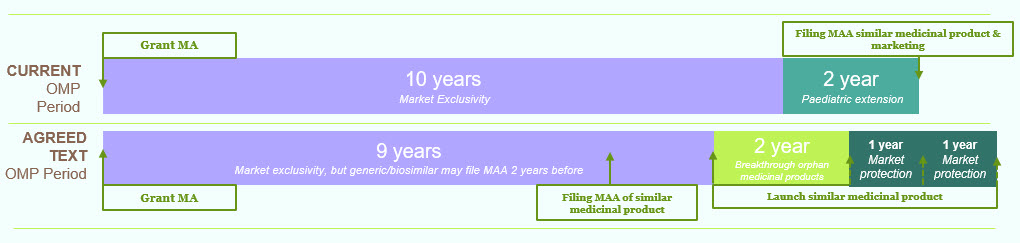
Currently marketing authorisation holders of designated orphan medicinal products (for rare diseases) in principle enjoy 10 years of market exclusivity, protecting them from acceptance of any application for or grant of a marketing authorisation for any similar medicinal product for the same therapeutic indication. This period is extended by two years of market exclusivity if the application included the results of all studies conducted in compliance with an agreed paediatric investigation plan – the so-called paediatric extension.
Under the new legislation, baseline market exclusivity will be reduced from 10 years to 9 years. Further, the paediatric extension does not return under the new legislation. The possible 6-month paediatric extension of the supplementary protection certificate remains.
Market exclusivity for breakthrough medicinal products, meaning if no medicine is authorised for the condition in the EU and the product delivers a clinically relevant reduction in disease morbidity or mortality, is extended by two years.
Also, where under the current framework no marketing authorisation application was accepted for the entire duration of the 10-years market exclusivity, application for similar medicinal (competitor) products may be submitted two years before expiration of OME under the new regime, i.e. after 7 years of initial grant of the marketing authorisation for the orphan medicinal product.
Where under the current legislation independent market exclusivity periods are received for every subsequent orphan indication authorised, one of the more significant changes under the new regime is the introduction of the Global Orphan Marketing Authorisation (“GOMA”).
With the GOMA, marketing authorisation holders shall no longer benefit from separate OME periods for subsequently approved orphan indications for the same medicinal product. Under the new regime every second or further indication for a different orphan condition for the same active substance by the same marketing authorisation holder will now (only) be provided an extension of the market exclusivity period of twelve months, maximally twice.
The newly introduced launch mechanism also applies to orphan medicinal products. Member States may request marketing authorisation holders to place products on the market and supply in sufficient quantities for the need of patients in that Member State. For this purpose, the Member State may request specific actions, such as the submission of a valid pricing and reimbursement application.
With regard to orphan medicinal products, prolongation, if any, of market exclusivity for new therapeutic indication for a different orphan condition does not apply in the specific Member States if the marketing authorisation holder does not comply with the request of that Member State. In that event, competitor products can effectively be launched in that Member State directly after expiry of the initial 9-year OME period.
The new pharmaceutical legislation is expected to become applicable in fall 2028 after the transition period. Marketing authorisation applications submitted before the end of the transition period shall be completed under the current regime and baseline orphan market exclusivity will apply to medicinal products authorised subsequently.
This is with exception to applications for orphan medicinal products with the same active substance. Although not clear-cut and not undisputed among industry associations and regulatory professionals, following the compromise text lastly published the GOMA and extension of marketing authorisation for a new orphan indication appear to apply from the date of entry into force of the new legislation (fall 2026).
Companies close to applying for second or further orphan marketing authorisations may consider accelerating submission and ensure marketing authorisation under the current regime if possible, benefiting from 10 years of orphan market exclusivity.
It should be further noted that Member States can start making launch mechanism requests 12 months after entry into force (expected from fall 2027) for products authorised after entry into force (expected fall 2026). Preparation for launch readiness in key Member States may be advised to protect market exclusivity in case extensions are expected.
Mapping indication development to capture potential extensions for breakthrough medicinal products is also beneficial.
Strategy is highly dependent on the specific product and timelines at hand. Reach out to the authors of this article or the Hogan Lovells attorneys with whom you regularly work, to discuss what the new legislation means for your products and how to optimise incentives and timelines.
Authored by Hein van den Bos and Julia Mischie.